Clinical Case by Dr. Mohd Hammo (Jordan)
Mandibular third molars with severe double curvature, narrow canals, and thin roots represent some of the most technically demanding cases in endodontics. The combination of S-shaped anatomy and limited dentin thickness significantly elevates the risk of instrument separation, ledge formation, and strip perforation. This clinical case demonstrates a controlled, dentin-preserving approach that prioritizes respect for the original canal morphology.
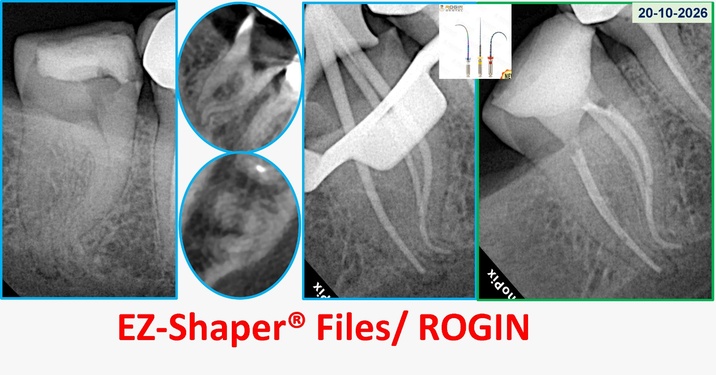
Case Details
- Tooth: Mandibular third molar
- Challenge: Severe double curvature (S-shaped anatomy) combined with narrow canals and thin root dentin
- Case Difficulty: Advanced (Double curvature, narrow canals, and thin roots)
Clinical Workflow
1. Access & Coronal Flaring
A conservative access cavity was prepared to preserve as much coronal tooth structure as possible. Early coronal flaring was then performed using EZx 15/.07. This step effectively eliminated coronal interferences, reduced torsional stress on subsequent instruments, and created a smoother pathway into the complex curvature.
2. Glide Path Management
A reproducible glide path was established to full working length. Initial canal scouting was carried out with a manual #10 K-file, followed by the rotary glide path file EZ1 15/.03. Confirming patency and creating a smooth, continuous pathway before introducing shaping instruments is critical in double-curved, narrow canals.
3. Canal Instrumentation
The mesial canals were shaped conservatively to a final size of 25/.04 using EZ-Shaper®. The instruments allowed controlled progression while respecting the double curvature and preserving critical dentin thickness. Unnecessary enlargement was deliberately avoided to minimize the risk of strip perforation in the thin-rooted anatomy.
4. Canal Irrigation
Copious irrigation combined with active agitation was performed throughout the procedure. Effective irrigation activation compensates for the conservative mechanical preparation by enhancing disinfection in areas beyond the physical reach of the instruments.
5. Root Canal Obturation
All canals were obturated to full working length while carefully maintaining the original canal curvature and anatomy. The final result reflected the conservative shaping strategy employed during instrumentation.
Clinical Tips
- Perform early coronal flaring with EZx 15/.07 to remove coronal interferences and reduce file stress in complex double curvatures.
- Always establish a patent and reproducible glide path to full working length with a #10 K-file and EZ1 15/.03 before introducing rotary shaping files.
- In narrow, double-curved roots with thin dentin, a conservative apical preparation such as 25/.04 is often sufficient when paired with thorough irrigation.
- Use active irrigation protocols to maximize deep canal disinfection and compensate for limited mechanical enlargement.
- Continuously respect the natural curvature and prioritize dentin preservation to avoid strip perforation and long-term structural compromise.
Key Message
In narrow, double-curved canals with thin roots, size 25/.04 can provide adequate shaping when combined with effective irrigation. Preserve dentin, respect the curvature, and avoid unnecessary enlargement.
Above all, challenging anatomy demands files you can trust. The controlled performance of EZ-Shaper®, supported by precise coronal flaring and glide path management, enabled a safe and predictable outcome in this complex mandibular third molar.