Case by Dr. Mohd Hammo – Jordan
Difficulty: Advanced (C-shaped canals with double curvature)
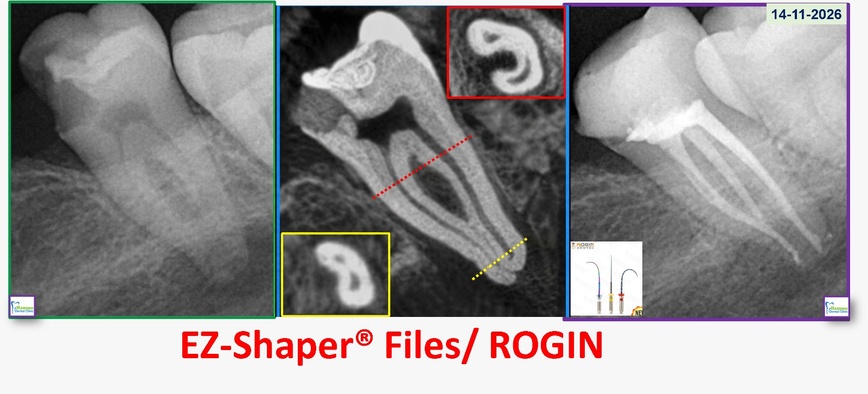
Complex canal anatomy in mandibular second molars remains one of the most challenging scenarios in endodontics. When a C-shaped canal system is combined with double curvature and thin root walls, the risk of transportation, perforation, and excessive dentin removal increases significantly. This clinical case demonstrates that aggressive enlargement is not required. A carefully controlled, conservative protocol using EZ-Shaper® files successfully managed the anatomy while preserving critical root structure.
Case Overview
- Tooth: Mandibular second molar
- Challenge: Complex C-shaped anatomy, double curvature, and thin roots
- Diagnosis: Not specified
The primary goal was to negotiate and shape the canals to a conservative final size while fully respecting the original canal morphology and minimizing removal of radicular dentin.
Clinical Workflow
1. Access
A conservative access cavity was prepared to maintain as much pericervical dentin as possible. Controlled coronal flaring was then performed using EZx 15/.07. This step improved visibility and created a straight-line path into the coronal third without unnecessary enlargement.
2. Glide Path
Initial negotiation to full working length was achieved with a #10 K-file. Once patency was confirmed, EZ1 15/.03 was used to establish a smooth, reproducible glide path. Creating a reliable glide path is essential in C-shaped canals with double curvature, as it reduces the risk of ledging or instrument separation during subsequent shaping.
3. Shaping
Canal preparation was completed conservatively to size 25/.04 using EZ-Shaper® files. The sequence respected both the double curvature and the complex C-shaped anatomy. By limiting the apical size and taper, canal transportation was minimized and critical root dentin was preserved—particularly important in thin-rooted mandibular second molars.
4. Irrigation
Copious irrigation with activation was performed throughout the procedure. Activation enhances the penetration of irrigants into fins, isthmuses, and other anatomical complexities that mechanical instruments cannot fully reach. This step is critical for thorough disinfection in C-shaped canal systems.
5. Obturation
All canals were obturated to working length while carefully respecting their original curvature and anatomical configuration. The conservative preparation facilitated a three-dimensional fill without forcing the material beyond the confines of the prepared space.
Key Clinical Message
Complex canal anatomy does not necessarily require aggressive enlargement.
In this case of C-shaped canals with double curvature and thin roots, conservative shaping to size 25/.04 with EZ-Shaper® was sufficient to achieve effective cleaning and shaping while safeguarding root integrity.
Clinical Tips
- Always respect double curvature and C-shaped anatomy—forceful instrumentation increases the risk of transportation.
- Establish a smooth, reproducible glide path before introducing shaping files.
- Limit preparation to a conservative 25/.04 size in thin-rooted teeth to preserve critical dentin.
- Activate irrigants to improve cleaning of fins, isthmuses, and anatomical complexities beyond the reach of mechanical instrumentation.
This case highlights the value of a controlled, anatomy-respecting approach in challenging mandibular second molars. By combining conservative access, a reliable glide path, and the EZ-Shaper® system limited to size 25/.04, clinicians can successfully manage C-shaped canals with double curvature while minimizing the risk of structural compromise.