A Clinical Case by Dr. Antonios Glynis
Specialist Endodontist — Crete Endodontics, Greece
Third molars are notorious in endodontics for their challenging positions and complex anatomy. Often located far back in the mouth, they present difficulties in isolation, access, and visibility. However, the greatest test frequently comes not from the tooth’s position, but from its internal anatomy — particularly in cases involving severely curved canals.
This clinical case highlights the successful management of a previously initiated LL8 (lower left third molar) with symptomatic apical periodontitis. The radiograph revealed significant curvatures, limited access, and a complex apical anatomy that demanded precision and respect rather than speed or force.
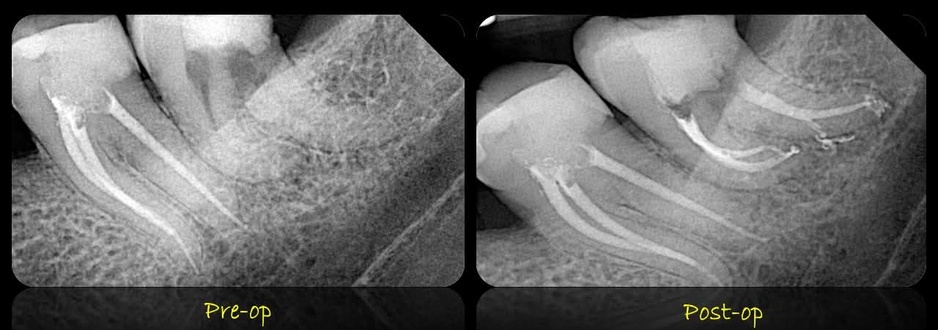
The Challenge: Curved Canals and Hidden Complexity in Third Molars
In endodontics, severely curved canals require a fundamentally different approach compared to straight, forgiving canals. Every step carries heightened importance:
- Access cavity design
- Glide path creation
- File selection and handling
- Irrigation protocol
- Recapitulation and patency maintenance
The primary risk is not merely failing to reach working length, but losing the original canal anatomy through ledge formation, transportation, zipping, blockage, or file separation. Excessive dentin removal can also compromise the long-term prognosis of the tooth.
In this LL8 case, the goal was clear: achieve thorough cleaning and shaping while strictly preserving the natural canal trajectory. This is where the choice of instrumentation becomes decisive.
Why Choose the Rogin R-Shaper System?
The R-Shaper system by Rogin was specifically selected for its philosophy of controlled, anatomy-respecting preparation — ideal for complex root canal treatments in challenging anatomy.
Key advantages of the R-Shaper system in this scenario:
- Designed to follow the canal rather than dominate it
- Excellent flexibility for negotiating severe curvatures
- Balanced efficiency without aggressive cutting
- Predictable performance that builds clinician confidence in difficult cases
Modern endodontics is no longer about forcing canals into a standardized shape. It is about cleaning, shaping, and obturating while honoring the anatomy nature provided. The R-Shaper system supports this respectful approach, making it particularly valuable for molars with complex curvatures.
Clinical Workflow: Step-by-Step Management
The case was approached with meticulous care:
- Access refinement under restricted visibility conditions typical of third molars.
- Conservative glide path creation — a non-negotiable step in curved canals to establish a safe, reproducible pathway.
- R-Shaper instrumentation (Rogin) using small, controlled movements with frequent recapitulation to maintain patency and prevent blockage.
- Effective irrigation utilizing a flexible polymer needle such as IrriFlex, which allows superior adaptation to curved anatomy and better delivery of irrigant to the apical third.
- Obturation of the prepared canal system.
Throughout the procedure, the focus remained on controlled progression rather than forceful advancement. This combination of precise mechanical shaping with the R-Shaper and optimized irrigation enabled safe and effective management of the complex canal system.
Clinical Tips for Managing Severely Curved Canals
- Glide path is essential — never skip or rush this step in curved anatomy.
- Shaping instruments should follow the anatomy, never force it.
- Perform frequent recapitulation to reduce the risk of blockage.
- Remember that shaping creates access, but irrigation performs the critical biological cleaning.
- Prioritize patience and control over speed in advanced endodontic cases.
Final Thoughts: Respect the Anatomy, Trust the Tools
Third molars will always carry a reputation for difficulty, but the real challenge often lies in their internal anatomy rather than their posterior position. In this LL8 case involving severe curvatures and symptomatic apical periodontitis, careful technique combined with the Rogin R-Shaper system allowed for a predictable outcome while preserving the original canal path.
This case demonstrates that with the right protocol and instrumentation, even intimidating anatomy becomes manageable. The R-Shaper system by Rogin delivers the control, flexibility, and respect for complex canal anatomy that modern endodontics demands.
Success in root canal treatment is not achieved by pushing harder — it comes from respecting the canal more.
