In the field of endodontics, treating teeth with complex root canal anatomy demands precision, proper technique, and reliable instruments. Dr. Mohd Hammo from Jordan recently managed a challenging root canal treatment (RCT) case involving a maxillary first premolar with two narrow canals exhibiting severe apical curvature. This case highlights the importance of conservative preparation and curvature respect in achieving predictable outcomes.
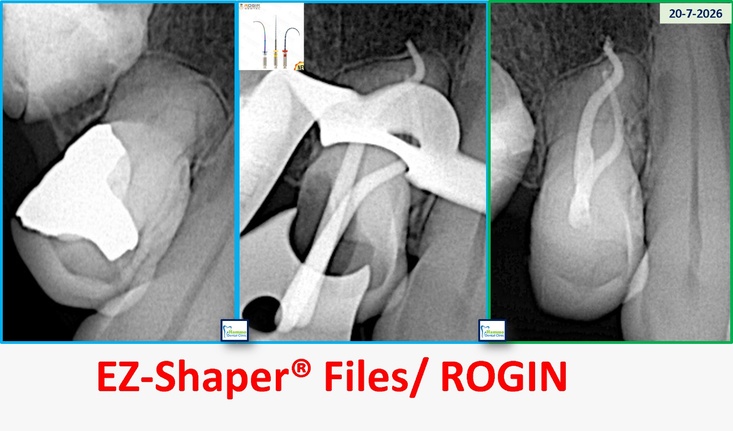
Case Overview
Tooth: Maxillary first premolar (Tooth 14/24)
Diagnosis: Pulpal pathology requiring root canal therapy
Challenge: Two narrow canals with severe apical curvature, increasing the risk of procedural errors such as ledging, perforation, or transportation.
Preoperative radiographs clearly revealed the complex anatomy, underscoring the need for a careful, stepwise approach to maintain the original canal curvature while ensuring thorough cleaning and shaping.
Clinical Workflow and Key Steps
Dr. Hammo followed a systematic clinical workflow that prioritized conservation of tooth structure and respect for the natural anatomy:
- Access Preparation: A conservative access cavity was created to locate both canals. Initial flaring was performed using the EZx file (15/.07) to improve straight-line access and reduce stress on subsequent instruments.
- Glide Path Creation: A reproducible glide path was established to full working length (WL) first with K-files #10, followed by enlargement using EZ1 (15/.03). This step proved critical in managing the severe curvatures safely.
- Canal Preparation: The canals were carefully shaped with EZ-Shaper® files, allowing controlled preparation that respected the original anatomy without excessive dentin removal.
- Irrigation and Disinfection: Copious irrigation combined with activation ensured effective cleaning and disinfection of the complex canal system.
- Obturation: Both canals were densely obturated to the working length, resulting in a well-sealed fill while beautifully preserving the tooth’s natural canal morphology.
Key Step Highlight: Establishing a secure glide path and employing controlled preparation techniques were essential in navigating and respecting the severe apical curvatures.
Why This Case Was Advanced
Maxillary first premolars with dual narrow canals and sharp apical curves represent an advanced endodontic case. The narrow anatomy limits instrument maneuverability, while severe curvatures heighten the risk of file separation or canal transportation. Success in such cases relies heavily on:
- Early conservative flaring
- A solid glide path foundation
- Flexible, efficient rotary files designed for curved canals
Clinical Tips from Dr. Mohd Hammo
- Glide path is the foundation — Always achieve full working length with a #10 K-file before advancing to rotary instruments.
- Use EZX (15/.07) for early flaring to minimize coronal stress and improve access.
- EZ1 (15/.03) serves as an excellent transition from manual glide path to the EZ-Shaper® system, creating a reproducible shape.
- In premolars with dual narrow canals, prioritize conservative shaping to preserve dentin and maintain the original anatomy for long-term success.
Conclusion: Mastering Complex Endodontics with Precision Tools
This successful root canal treatment by Dr. Mohd Hammo demonstrates how meticulous planning and the strategic use of specialized files like the EZ series (EZx, EZ1, and EZ-Shaper®) can overcome significant anatomical challenges. For endodontists and general practitioners facing similar complex cases, focusing on glide path management and conservative techniques remains paramount.
