Dr. Nebras
Libya
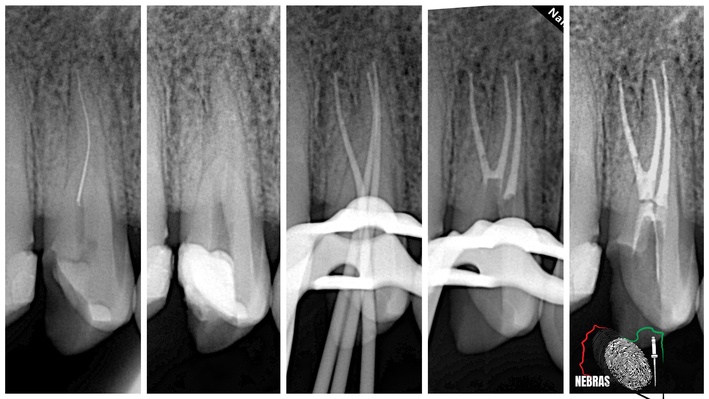
This advanced complex endodontic case involves a molarized premolar diagnosed with symptomatic apical periodontitis. The treatment was complicated by a separated instrument, severely narrowed canals, and overall complex anatomy, requiring precise technique and careful instrument management to achieve a successful outcome.
Case Overview
The tooth presented as a molarized premolar with symptomatic apical periodontitis. Key challenges included:
- Presence of a broken file (separated instrument)
- Severely narrowed canals
- Complex root canal anatomy
These factors increased the difficulty of both instrument retrieval and subsequent cleaning and shaping, making microscopic visualization and a controlled workflow essential.
Clinical Workflow
The treatment followed a structured and conservative sequence:
- Access
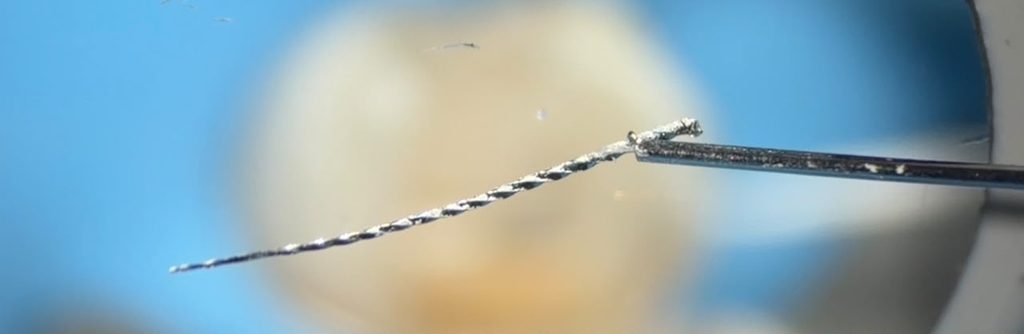
Ultrasonic troughing was performed to carefully expose and reach the separated instrument while preserving surrounding tooth structure. - Retrieval
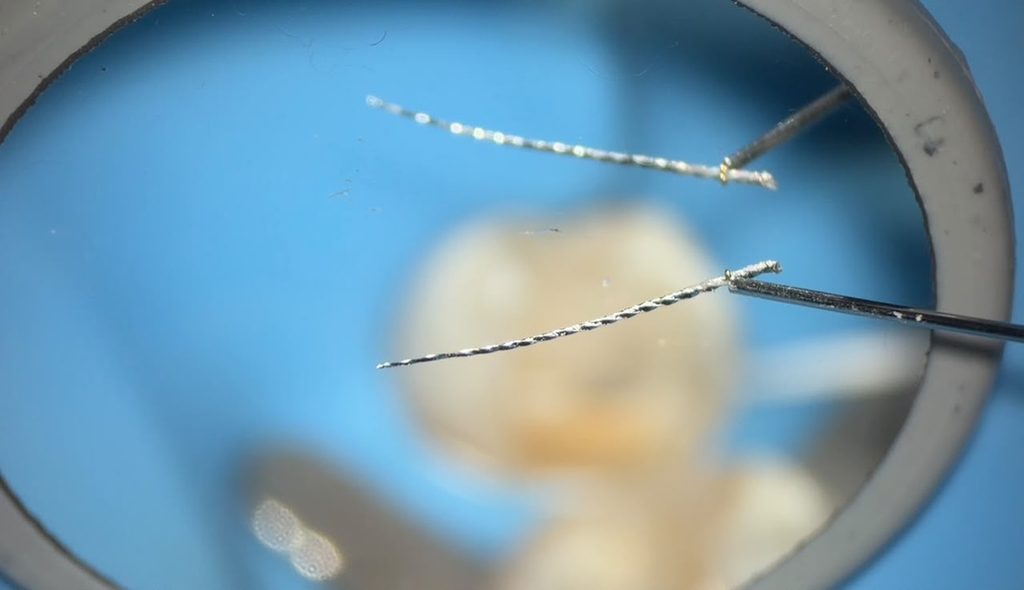
The wire-and-loop technique was applied under the operating microscope to retrieve the broken file with precision and minimal risk of further complications. - Glide Path
A manual glide path was first established with a K-file #10, followed by a Rogin Path File #15/.03 to create a smooth pathway and reduce coronal resistance. - Instrumentation
Shaping was completed using the Super Flexi (Aurora) system:- Buccal canal: 25/.04
- Palatal canal: 30/.04
- Irrigation and Obturation
Irrigation was activated, followed by hot obturation to achieve a dense and effective three-dimensional seal.
Clinical Tips
- Straight-line access is essential — suboptimal access significantly raises the risk of instrument separation.
- Microscopic visualization ensures precise and controlled wire-and-loop retrieval of separated instruments.
- Complex and narrow anatomy demands establishing a manual glide path before introducing rotary instruments.
- A rotary path file helps reduce coronal resistance, allowing safer and more predictable progression.
- Conservative shaping (25/.04) helps preserve root structural integrity in already compromised or narrow canals.
Conclusion
This complex endodontic case of a molarized premolar with a separated instrument and severely narrowed canals demonstrates the importance of straight-line access, microscopic precision, staged glide-path preparation, and conservative shaping. Careful instrument retrieval combined with controlled instrumentation and effective obturation supports predictable outcomes even in advanced cases involving broken files and complex anatomy.
