Root canal treatment of molars with narrow canals and moderate curvature requires a careful, anatomy-preserving approach. This clinical case from Jordan, performed by Dr. Mohd Hammo, demonstrates a conservative protocol using the EZ system for managing a lower first molar with challenging canal morphology.
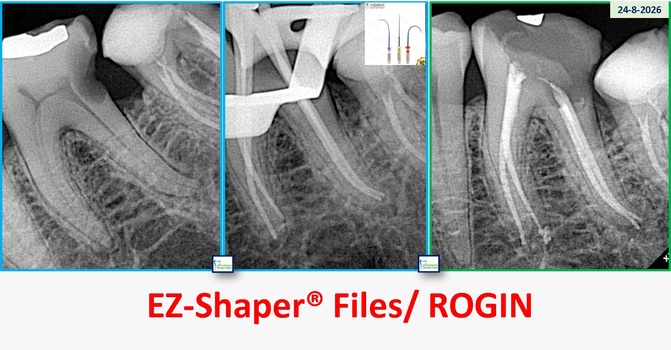
Case Overview
The patient presented with a lower first molar (tooth 36/46) requiring root canal treatment due to pulpal pathology. Radiographic evaluation revealed narrow canals with moderate curvature—a common clinical challenge that demands precise instrumentation to avoid iatrogenic errors while achieving thorough cleaning and shaping.
Case Difficulty: Standard
Tooth: Lower first molar (36/46)
Diagnosis: Pulpal pathology requiring RCT
Primary Challenge: Narrow canals with moderate curvature
Preoperative Analysis
Preoperative radiographs clearly showed the presence of narrow canals exhibiting moderate curvature. These anatomical features increase the risk of file separation, ledging, or excessive dentin removal if aggressive instrumentation is used. A conservative strategy was therefore selected to respect the original canal anatomy while ensuring adequate disinfection and obturation.
Clinical Workflow
1. Access Preparation
A conservative access cavity was prepared to minimize structural compromise of the tooth. Coronal flaring was then performed using the EZx 15/.07 file. Early coronal flaring reduces stress on subsequent instruments and facilitates safer negotiation of the curved and narrow portions of the canals.
2. Glide Path Establishment
A reproducible glide path was first created to full working length using #10 K-files. The path was then enlarged with the EZ1 15/.03 file. Establishing a secure glide path is a critical prerequisite before introducing rotary instruments in narrow canals, as it significantly reduces the risk of instrument fracture and transportation.
3. Canal Preparation
The canals were carefully shaped with EZ-Shaper® files. Instrumentation was performed with a focus on remaining conservative and preserving the original canal anatomy. This approach prioritizes dentin preservation while still achieving sufficient enlargement for effective irrigation and obturation.
4. Irrigation and Cleaning
Copious irrigation combined with activation was employed throughout the procedure to enhance disinfection. In narrow and curved canals, mechanical instrumentation alone is often insufficient; thorough chemical cleaning is essential for removing residual tissue and microorganisms.
5. Obturation
All canals were densely obturated to working length. The final fill demonstrated excellent adaptation while preserving the original canal anatomy, confirming that the conservative shaping protocol had successfully maintained the natural morphology of the root canal system.
Key Clinical Insights
In cases involving narrow canals, the guiding principle is conservatism: preserve as much dentin as possible while still achieving adequate cleaning and shaping. Aggressive enlargement can weaken the tooth structure and increase the risk of complications, particularly in molars with curved anatomy.
Clinical Tips from Dr. Mohd Hammo
- In narrow canals, conservative shaping with systems such as EZ-Shaper® helps preserve dentin while still delivering effective cleaning and shaping.
- Always establish a secure and reproducible glide path (e.g., with #10 K-files followed by EZ1 15/.03) before progressing to rotary instrumentation.
- Early coronal flaring with the EZx 15/.07 reduces coronal interference and lowers stress on subsequent files negotiating the apical and mid-root curvatures.
Conclusion
This case illustrates a predictable, anatomy-respecting approach to root canal treatment of a lower first molar with narrow, moderately curved canals. By combining conservative access, early coronal flaring, a secure glide path, controlled shaping with EZ-Shaper® files, activated irrigation, and dense obturation, Dr. Mohd Hammo achieved a successful outcome while preserving the original canal morphology and maximizing remaining tooth structure.
Conservative techniques remain essential when managing complex canal anatomy. Careful case selection, adherence to a stepwise protocol, and respect for the natural anatomy continue to be the foundation of predictable endodontic success.
