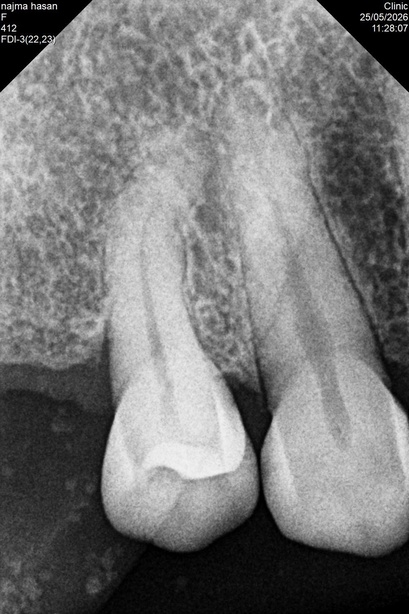
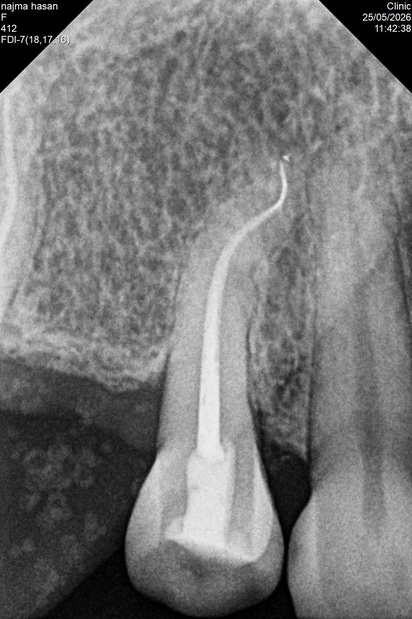
S-shaped canal curvature ranks among the more demanding anatomical challenges in endodontics. Double curves increase the risk of transportation, ledge formation, and instrument fatigue, making careful length control and flexible instrumentation essential. This clinical case, performed by Dr. Radwan Alnabelsi in Bahrain, presents a successful root canal treatment of an upper premolar (#15) diagnosed with symptomatic irreversible pulpitis and featuring a pronounced S-shaped canal.

Case Difficulty
Advanced – S-shaped canal anatomy requiring precise working length control and flexible preparation to preserve the original canal path.
Case Details
- Tooth: Upper premolar (#15)
- Diagnosis: Symptomatic irreversible pulpitis (SIP)
- Challenge: Management of S-shaped canal curvature while maintaining the original anatomy and achieving thorough cleaning.
Clinical Workflow
1. Working Length Determination
Working length was established using the AirPex electronic apex locator. Accurate length determination is particularly important in S-shaped canals to avoid over-instrumentation beyond the apical constriction and to guide safe preparation through both curves.
2. Mechanical Preparation
Canal shaping was performed with Rogen EZ-Shaper heat-treated nickel-titanium files. The enhanced flexibility of heat-treated files helps negotiate double curvatures more safely, reducing the risk of straightening the canal or creating iatrogenic complications.
3. Irrigation Protocol
A sequential irrigation regimen was applied:
- Sodium hypochlorite for tissue dissolution and disinfection
- Saline
- EDTA for smear layer removal
- Final saline rinse
4. Activation
Passive ultrasonic activation was performed with the Ultra-X device. In curved canals, ultrasonic activation improves irrigant penetration and helps compensate for the limitations of mechanical preparation alone.
Clinical Tips for Managing S-Shaped Canals
- Establish and continuously verify working length with a reliable apex locator such as AirPex before and during preparation.
- Prefer heat-treated files like Rogen EZ-Shaper for their superior flexibility when negotiating double curvatures.
- Follow a systematic irrigation sequence (sodium hypochlorite → saline → EDTA → saline) to optimize cleaning.
- Incorporate passive ultrasonic activation (Ultra-X) to enhance irrigant effectiveness in anatomically complex canals.
Key Takeaways
Successful management of an S-shaped canal depends on accurate working length control, the use of flexible heat-treated instruments, and activated irrigation. This case by Dr. Radwan Alnabelsi demonstrates how a structured approach with modern heat-treated NiTi files and ultrasonic activation can support predictable outcomes even in advanced anatomical situations.
Careful case assessment, respect for the original canal path, and methodical technique remain essential when treating teeth with significant canal curvature.
