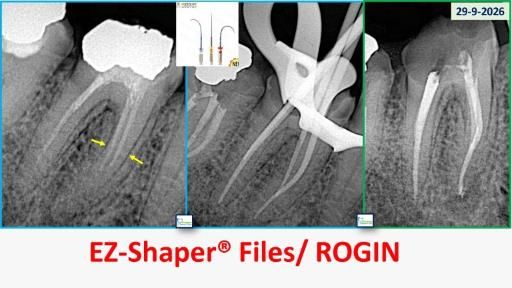
Dr. Mohd Hammo presents a practical intermediate-level case highlighting the importance of preserving original canal anatomy during root canal treatment of a mandibular first molar with narrow, curved canals.
Case Overview
Tooth: Mandibular first molar
Location: Jordan
Clinician: Dr. Mohd Hammo
Difficulty: Intermediate
Primary Challenge: Avoid excessive enlargement and preserve the original canal anatomy
In teeth with narrow, curved canals, the temptation to over-prepare can lead to unnecessary dentin removal, increased risk of lateral perforation, and long-term structural compromise. This case demonstrates a conservative, anatomy-respecting approach using a controlled sequence of instruments and techniques.
Clinical Workflow
1. Access & Coronal Flaring
A conservative access cavity was prepared, followed by coronal flaring with the EZx 15/.07. This step creates space in the coronal third while minimizing the removal of sound tooth structure, setting the stage for safer negotiation of the curved canals.
2. Glide Path Establishment
A reproducible glide path was first established to full working length using a #10 K-file. The path was then enlarged with the EZ1 15/.03. Creating a secure glide path before rotary shaping is essential in narrow, curved canals to reduce the risk of instrument separation and ledging.
3. Shaping of the Mesial Canals
The mesial canals were shaped conservatively with the EZ-Shaper® to a final size of 25/.04. This limited apical preparation size was deliberately chosen to minimize the risk of lateral perforation and avoid unnecessary dentin removal, while still providing adequate space for irrigation and obturation.
4. Irrigation
Copious irrigation with activation was performed throughout the procedure. Activation improves the penetration of irrigants into areas of the canal system that instruments cannot physically reach, enhancing disinfection without the need for larger preparation sizes.
5. Obturation
All canals were densely obturated to full working length while maintaining their original anatomy. The conservative preparation allowed for a three-dimensional fill without over-enlargement of the canal walls.
Key Clinical Message
In narrow curved canals, do not over-prepare. A final size of 25/.04 can provide adequate shaping for effective cleaning and obturation while preserving critical dentin and respecting the natural canal anatomy.
Clinical Tips
- Preserve dentin with conservative preparation rather than aggressive enlargement
- Always establish a full-length glide path before introducing shaping instruments
- Match the final preparation size to the individual canal anatomy
- Use activated irrigation to disinfect areas beyond the physical reach of instruments
This case reinforces that successful endodontic treatment in narrow, curved canals depends less on large preparation sizes and more on controlled, anatomy-driven instrumentation, thorough irrigation, and careful obturation. By prioritizing the preservation of original canal morphology, clinicians can achieve both clinical success and long-term tooth survival.
