Dr. Antonios Glynis
Greece
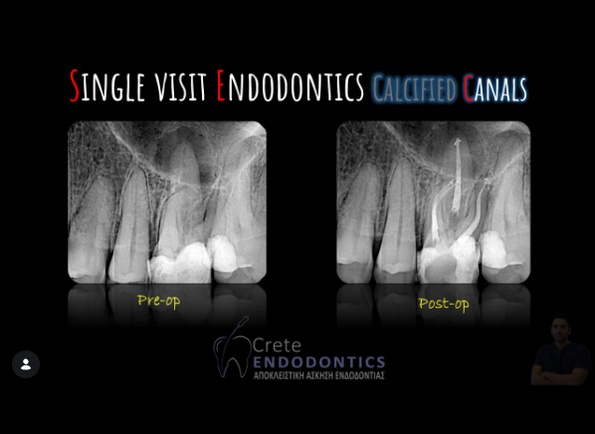
Root canal treatment becomes significantly more demanding when pulp canal calcification is present. In this advanced clinical case involving tooth 26 (UL6), the canals exhibited significant canal calcification combined with extremely narrow canals. Much of the difficulty arose before any shaping could begin: identifying the canal orifices, negotiating the canals, and establishing a safe, reproducible pathway to working length.
Pulp canal calcification is a well-recognised factor that increases the complexity of root canal treatment. It particularly complicates canal location, negotiation, and instrumentation, raising the potential for procedural complications if not approached carefully.
The Critical Principle in Calcified Cases
The key point in cases like this is clear:
Do not chase the canal by removing more dentine.
Success depends on magnification, controlled access, tactile feedback, and gradual glide-path development. These elements transform an almost invisible canal into one that can be shaped safely and predictably.
In this UL6, all canals were extremely narrow and demanding to negotiate. Once patency and a reproducible glide path had been established, shaping was completed with the ROGIN R-Shaper.
This is where the ROGIN R-Shaper proves particularly valuable. After the most difficult phase of the case has been managed, the rotary preparation needs to progress in a controlled manner. The instrument maintains the pathway that has already been carefully created rather than attempting to force the anatomy.
Clinical Workflow
- Locate canal orifices with magnification and controlled access
- Negotiate canals; establish patency and a reproducible glide path
- Shape with ROGIN R-Shaper along the established pathway
Clinical Tips for Calcified and Narrow Canals
- Preserve dentine during canal location
- Use tactile feedback for gradual negotiation
- Establish a reproducible glide path before shaping
- Follow the canal pathway without forcing instruments
Difficulty Level
Advanced
Case Summary
- Tooth: 26 (UL6)
- Diagnosis: Not specified
- Challenge: Calcified, extremely narrow canals
In highly calcified and narrow canal systems, the foundation of a successful outcome is laid long before rotary instruments are introduced. Careful orifice location, patient negotiation, and a secure glide path create the conditions for controlled shaping. Instruments such as the ROGIN R-Shaper then allow the clinician to refine the preparation while respecting the pathway that has already been established.
